
Egypt
Egypt - Nefertiti
Egypt - Nefertiti
Duration
11 days
Start/End
Cairo
Tour type
Group
Level
Easy
Accommodation
Hotels and Lodges
Overview
With a local German-speaking guide you travel back 4,500 years: the Valley of the Kings, Karnak Temple, a hot-air balloon ride, a Nile cruise via Edfu and Kom Ombo to Aswan, a felucca trip and Abu Simbel – with a finale in Cairo at the Alabaster Mosque and the pyramids.
Traveling back 4,500 years in almost two weeks is quite an achievement. But it's nothing compared to the ancient wonder of the world, still guarded by the Sphinx. Tutankhamun, Ramses, Thutmose, and the God's Wife Hatshepsut—they are all your companions before you leave the dust of history and step onto the eternal waters of life: a Nile cruise to the Aswan Dam and back to a magnificent finale: the Alabaster Mosque, the symbol of Cairo. And over it all, the sun god Amun-Re holds his warm hand. Cairo awaits you with the Pyramids of Giza and the Grand Egyptian Museum, the sacred temples of Luxor and the impressive Aswan Dam. For four days you will sail on a stylish boat along the Nile and visit a village on the Nile island of Bisaw. Sail 180 kilometers on a traditional sailing ship down the river of all rivers, watch world cultures drift by, and disembark wherever your adventurous spirit senses archaeological wonders. And in between: soak up the sun, play a round of backgammon, and constantly dream and marvel.
Tour Code
Tour language
 German
Itinerary
Day 1
Welcome to Egypt
Embrace Hotel
approx. 30 km
"Marhaba" in the land of pyramids and pharaohs. Ramses, Tutankhamun, Akhenaten, and Nefertiti are all waiting for you! You'll arrive via Cairo at Luxor airport, where your tour guide will meet you and take you to your hotel. Please ensure your luggage is checked through to Luxor when checking in at the airport. A representative from our local partner agency will meet you in the arrivals area of Cairo Airport and assist you with your visa application. You will pay for the visa at the official bank counters in front of the passport control desks. And regarding your connecting flight: don't worry, your plane will wait for you. Your tour guide will meet you outside the arrivals hall. If you are not arriving on the group flight, the bus driver may meet you. Embrace Hotel: The Embrace Hotel is located on the west bank of the Nile, just a stone's throw from the Valley of the Kings. Clay-plastered walls and a verdant atrium with a trickling fountain create a welcoming atmosphere. The air-conditioned rooms are decorated in warm colors and with local materials, inviting guests to relax and unwind. The lush garden offers plenty of seating areas perfect for a break, and those who get too hot can cool off in the pool.
Welcome to Egypt
Day 1
Embrace Hotel
approx. 30 km
"Marhaba" in the land of pyramids and pharaohs. Ramses, Tutankhamun, Akhenaten, and Nefertiti are all waiting for you! You'll arrive via Cairo at Luxor airport, where your tour guide will meet you and take you to your hotel. Please ensure your luggage is checked through to Luxor when checking in at the airport. A representative from our local partner agency will meet you in the arrivals area of Cairo Airport and assist you with your visa application. You will pay for the visa at the official bank counters in front of the passport control desks. And regarding your connecting flight: don't worry, your plane will wait for you. Your tour guide will meet you outside the arrivals hall. If you are not arriving on the group flight, the bus driver may meet you. Embrace Hotel: The Embrace Hotel is located on the west bank of the Nile, just a stone's throw from the Valley of the Kings. Clay-plastered walls and a verdant atrium with a trickling fountain create a welcoming atmosphere. The air-conditioned rooms are decorated in warm colors and with local materials, inviting guests to relax and unwind. The lush garden offers plenty of seating areas perfect for a break, and those who get too hot can cool off in the pool.
Day 2
The Valley of the Kings
Embrace Hotel
approx. 30 km
On today's to-do list is the Valley of the Kings, west of the Nile, beyond the floodplains. Here lie the colorfully decorated necropolises of the pharaohs of the New Kingdom (c. 1500 to 1100 BC). A total of 65 tombs have been discovered, the vast majority of which have already been plundered by grave robbers. Only the treasure-filled tomb of Tutankhamun remained undiscovered for a long time. To protect the fragile tombs, only a handful are open to visitors at any one time. Today you will visit three of them; which ones are decided by the god of fate, Shai. Also worth a visit is the house of Howard Carter. He was the one who discovered Tutankhamun's magnificent tomb in 1922. Directly behind it is a remarkable replica of Tutankhamun's burial chamber, waiting to be explored. In a small pottery workshop, you can observe how some of the grave goods from that era were made. You'll gain insight into the traditional techniques and methods of producing Egyptian pottery, and your visit will not only support the preservation of traditional craftsmanship but also the local community. In the afternoon, the magnificent terraced temple of Hatshepsut is on the agenda, its architecture appearing both ancient and modern. Queen Hatshepsut was one of the few women to ascend the pharaoh's throne. To legitimize her rule as a woman, she constantly asserted her divine lineage, which is also depicted in the reliefs inside the temple. Breakfast, a picnic lunch and dinner are included in the price. You will stay in the same accommodation as the previous day.
The Valley of the Kings
Day 2
Embrace Hotel
approx. 30 km
On today's to-do list is the Valley of the Kings, west of the Nile, beyond the floodplains. Here lie the colorfully decorated necropolises of the pharaohs of the New Kingdom (c. 1500 to 1100 BC). A total of 65 tombs have been discovered, the vast majority of which have already been plundered by grave robbers. Only the treasure-filled tomb of Tutankhamun remained undiscovered for a long time. To protect the fragile tombs, only a handful are open to visitors at any one time. Today you will visit three of them; which ones are decided by the god of fate, Shai. Also worth a visit is the house of Howard Carter. He was the one who discovered Tutankhamun's magnificent tomb in 1922. Directly behind it is a remarkable replica of Tutankhamun's burial chamber, waiting to be explored. In a small pottery workshop, you can observe how some of the grave goods from that era were made. You'll gain insight into the traditional techniques and methods of producing Egyptian pottery, and your visit will not only support the preservation of traditional craftsmanship but also the local community. In the afternoon, the magnificent terraced temple of Hatshepsut is on the agenda, its architecture appearing both ancient and modern. Queen Hatshepsut was one of the few women to ascend the pharaoh's throne. To legitimize her rule as a woman, she constantly asserted her divine lineage, which is also depicted in the reliefs inside the temple. Breakfast, a picnic lunch and dinner are included in the price. You will stay in the same accommodation as the previous day.
Day 3
The Karnak Temple and embarkation on the Nile
Golden Safiya
approx. 100 km
In the morning, you'll explore Egypt's largest and arguably most impressive temple complex, the temple city of Karnak. This gigantic sanctuary was built in honor of the sun god Amun-Re and continuously expanded over two millennia by numerous pharaohs to pay him due tribute. The oldest structures are approximately 4,000 years old. Personalities such as Seti I and his son Ramses II, for example, commissioned the monumental hypostyle hall between the first and second pylons. You'll then be taken to Esna to visit its temple, explore the old town and market, and visit the medieval caravanserai. Now it's time to digest the impressions gathered over the past few days. From now on, we'll slow down your pace of travel—by water. One of the most classic ways to experience the Nile is on the traditional dahabiya. Do these small sailing vessels remind you of the cargo barges depicted in almost every relief painting? No wonder, since these types of ships have been sailing the river of all rivers and the country's most important transport artery for thousands of years. Make yourself comfortable on the sun deck – in the coming days you'll sail leisurely upstream, letting the wind set the pace all the way to Aswan. Along the way, you'll make frequent stops to explore the riverbanks. Breakfast, lunch and dinner are included. You will receive a warm welcome from the ship's crew in Esna. International guests are also welcome to join the trip on the Dahabiya. Want to experience even more? Here's our recommendation: Experience a hot air balloon ride over the west bank of the Nile at sunrise and watch as the temple complexes of Karnak and Luxor are illuminated in the morning light. The price for the approximately one-hour hot air balloon ride is €95 per person. Gratuity is not included. Other international guests may also participate in the trip. The duration and route of the trip depend on the weather and wind conditions. Please register for the excursion with your tour guide on site. Dahabiya Safiya: Welcome aboard the Dahabiya Safiya. This traditional sailing vessel features comfortable suites with air conditioning and private bathrooms. The ship is equipped with solar panels for electricity generation, solar water heaters, and LED lighting. Sun loungers are available on the sun deck, where you can relax and watch the activity along the Nile. The crew members come from small villages along the route and can offer helpful tips throughout the voyage and connect you with locals during shore excursions. And if that's not enough, you can also unwind in the jacuzzi.
The Karnak Temple and embarkation on the Nile
Day 3
Golden Safiya
approx. 100 km
In the morning, you'll explore Egypt's largest and arguably most impressive temple complex, the temple city of Karnak. This gigantic sanctuary was built in honor of the sun god Amun-Re and continuously expanded over two millennia by numerous pharaohs to pay him due tribute. The oldest structures are approximately 4,000 years old. Personalities such as Seti I and his son Ramses II, for example, commissioned the monumental hypostyle hall between the first and second pylons. You'll then be taken to Esna to visit its temple, explore the old town and market, and visit the medieval caravanserai. Now it's time to digest the impressions gathered over the past few days. From now on, we'll slow down your pace of travel—by water. One of the most classic ways to experience the Nile is on the traditional dahabiya. Do these small sailing vessels remind you of the cargo barges depicted in almost every relief painting? No wonder, since these types of ships have been sailing the river of all rivers and the country's most important transport artery for thousands of years. Make yourself comfortable on the sun deck – in the coming days you'll sail leisurely upstream, letting the wind set the pace all the way to Aswan. Along the way, you'll make frequent stops to explore the riverbanks. Breakfast, lunch and dinner are included. You will receive a warm welcome from the ship's crew in Esna. International guests are also welcome to join the trip on the Dahabiya. Want to experience even more? Here's our recommendation: Experience a hot air balloon ride over the west bank of the Nile at sunrise and watch as the temple complexes of Karnak and Luxor are illuminated in the morning light. The price for the approximately one-hour hot air balloon ride is €95 per person. Gratuity is not included. Other international guests may also participate in the trip. The duration and route of the trip depend on the weather and wind conditions. Please register for the excursion with your tour guide on site. Dahabiya Safiya: Welcome aboard the Dahabiya Safiya. This traditional sailing vessel features comfortable suites with air conditioning and private bathrooms. The ship is equipped with solar panels for electricity generation, solar water heaters, and LED lighting. Sun loungers are available on the sun deck, where you can relax and watch the activity along the Nile. The crew members come from small villages along the route and can offer helpful tips throughout the voyage and connect you with locals during shore excursions. And if that's not enough, you can also unwind in the jacuzzi.
Hot air balloon ride
Experience a hot air balloon ride over the west bank of the Nile at sunrise and watch as the temple complexes of Karnak and Luxor are illuminated in the morning light. The price for the approximately one-hour hot air balloon ride is €95 per person. Gratuity is not included. Other international guests may also participate in the trip. The duration and route of the trip depend on the weather and wind conditions. Please register for the excursion with your tour guide on site.
Day 4
El-Kab and Edfu
Golden Safiya
Enjoy a relaxing morning on deck and watch life unfold along the Nile. Read a book or simply savor the moment. Sooner or later – depending on how favorable the wind is today – you'll arrive in el-Kab and moor here for a short stop. The ancient city of el-Kab – also known as Nekheb – was once one of the largest cities in ancient Egypt and was dedicated to the protective goddess Nekhbet. Sections of the mud-brick wall, up to eleven meters thick, that once encircled the city are still visible today. Just outside the wall lies a necropolis with 31 rock-cut tombs, some decorated with well-preserved, colorful reliefs. A little further upstream, you'll reach the Temple of Horus in Edfu, dedicated to the sky god of the same name. It is one of the best-preserved temples in the entire country, despite being around 2,000 years old. In Egyptian mythology, Horus is depicted as a falcon, among other things. It's therefore no surprise that the imposing entrance pylon, nearly 70 meters wide, greets you with two larger-than-life falcon statues. Legend has it that Horus fought against his uncle Seth, with whom he disputed the rightful succession to the throne. The outcome of this battle is revealed by the hieroglyphs inside the temple, which lay half-buried in the desert sand until their uncovering in 1860. Breakfast, lunch and dinner are included in the price. You will stay in the same accommodation as the previous day.
El-Kab and Edfu
Day 4
Golden Safiya
Enjoy a relaxing morning on deck and watch life unfold along the Nile. Read a book or simply savor the moment. Sooner or later – depending on how favorable the wind is today – you'll arrive in el-Kab and moor here for a short stop. The ancient city of el-Kab – also known as Nekheb – was once one of the largest cities in ancient Egypt and was dedicated to the protective goddess Nekhbet. Sections of the mud-brick wall, up to eleven meters thick, that once encircled the city are still visible today. Just outside the wall lies a necropolis with 31 rock-cut tombs, some decorated with well-preserved, colorful reliefs. A little further upstream, you'll reach the Temple of Horus in Edfu, dedicated to the sky god of the same name. It is one of the best-preserved temples in the entire country, despite being around 2,000 years old. In Egyptian mythology, Horus is depicted as a falcon, among other things. It's therefore no surprise that the imposing entrance pylon, nearly 70 meters wide, greets you with two larger-than-life falcon statues. Legend has it that Horus fought against his uncle Seth, with whom he disputed the rightful succession to the throne. The outcome of this battle is revealed by the hieroglyphs inside the temple, which lay half-buried in the desert sand until their uncovering in 1860. Breakfast, lunch and dinner are included in the price. You will stay in the same accommodation as the previous day.
Day 5
Fishing on the Nile
Golden Safiya
For a traditional and authentic Egyptian breakfast, you'll leave your dahabiya in the morning and visit a small village on Bisaw Island. Today, the Egyptians will once again demonstrate their innate hospitality. Fortunately, you won't have to resist the enticing aromas of falafel (deep-fried chickpea balls), foul (a bean dish), and freshly baked bread for long. Afterward, you'll take a stroll through the village and meet a fisherman who will invite you aboard his boat. He'll explain his craft, and perhaps you'll be lucky enough to catch your dinner together? Further upriver, you'll reach a section where the Nile Valley narrows considerably. Here, the river once carved its way through the soft rock massif. The Gebel es-Silsileh quarry, where sandstone was extracted for the temples of Karnak and Luxor, is clearly visible. In some places, cuts up to 20 meters high were made to access the sought-after building material. The stone blocks could then be transported quickly and easily to their respective destinations via the river. Breakfast, lunch and dinner are included. You will stay in the same accommodation as the previous day.
Fishing on the Nile
Day 5
Golden Safiya
For a traditional and authentic Egyptian breakfast, you'll leave your dahabiya in the morning and visit a small village on Bisaw Island. Today, the Egyptians will once again demonstrate their innate hospitality. Fortunately, you won't have to resist the enticing aromas of falafel (deep-fried chickpea balls), foul (a bean dish), and freshly baked bread for long. Afterward, you'll take a stroll through the village and meet a fisherman who will invite you aboard his boat. He'll explain his craft, and perhaps you'll be lucky enough to catch your dinner together? Further upriver, you'll reach a section where the Nile Valley narrows considerably. Here, the river once carved its way through the soft rock massif. The Gebel es-Silsileh quarry, where sandstone was extracted for the temples of Karnak and Luxor, is clearly visible. In some places, cuts up to 20 meters high were made to access the sought-after building material. The stone blocks could then be transported quickly and easily to their respective destinations via the river. Breakfast, lunch and dinner are included. You will stay in the same accommodation as the previous day.
Day 6
Kom Ombo and the Daraw Market
Golden Safiya
You continue your leisurely cruise upstream until you reach Kom Ombo. The double temple rises several meters above the river level, seemingly made for a photograph. The Nile also makes a bend here, making the structure particularly striking. Double temple? You read that right, as this complex is dedicated to two deities. You're already quite familiar with one of them: Horus, who appears in the form of a falcon. The other is the crocodile god Sobek. The double gate forms the main entrance. Through the left gate, you enter the Temple of Sobek, while the right gate leads to the identically designed Temple of Horus. Two parallel axes guide you further inside. Following the principle of layering onions, the inner sanctum is shielded from the outside world by several surrounding walls. A little south of Kom Ombo lies the small town of Daraw. At the local market, farmers from the surrounding area sell fresh fruit and vegetables they've grown themselves. At the market stalls, tomatoes, beans, onions, pomegranates, dates, and citrus fruits are piled high. The friendly vendors are always happy to chat and appreciate your interest. Take the time to talk to the farmers or simply observe the vibrant activity of the market. Breakfast, lunch and dinner are included today. You will stay in the same accommodation as the previous day.
Kom Ombo and the Daraw Market
Day 6
Golden Safiya
You continue your leisurely cruise upstream until you reach Kom Ombo. The double temple rises several meters above the river level, seemingly made for a photograph. The Nile also makes a bend here, making the structure particularly striking. Double temple? You read that right, as this complex is dedicated to two deities. You're already quite familiar with one of them: Horus, who appears in the form of a falcon. The other is the crocodile god Sobek. The double gate forms the main entrance. Through the left gate, you enter the Temple of Sobek, while the right gate leads to the identically designed Temple of Horus. Two parallel axes guide you further inside. Following the principle of layering onions, the inner sanctum is shielded from the outside world by several surrounding walls. A little south of Kom Ombo lies the small town of Daraw. At the local market, farmers from the surrounding area sell fresh fruit and vegetables they've grown themselves. At the market stalls, tomatoes, beans, onions, pomegranates, dates, and citrus fruits are piled high. The friendly vendors are always happy to chat and appreciate your interest. Take the time to talk to the farmers or simply observe the vibrant activity of the market. Breakfast, lunch and dinner are included today. You will stay in the same accommodation as the previous day.
Day 7
Aswan
Arteka Wadi Kiki Guesthouse
approx. 30 km
In the morning, you'll arrive in Aswan and say goodbye to the crew. Even in Pharaonic Egypt, Aswan was the southernmost border city of the country; beyond it lay Nubia. Many Nubians still live in and around Aswan today, so their unique culture continues to thrive here. On the way to the Philae Temple, your bus will stop at the Aswan High Dam – a structure celebrated in Egypt as a modern wonder of the world. However, the project is not without controversy: the creation of Lake Nasser forced the resettlement of around 90,000 Nubians. Furthermore, numerous historical relics were literally doomed. The cultural highlight is the Philae Temple, dedicated to the goddess Isis. Afterward, you'll board a motorboat and be maneuvered through the Nile cataracts. Over a stretch of about five kilometers south of Aswan, numerous boulders jut out of the water, creating rapids and narrow passages. For the ancient Egyptians, crossing this stretch of water was unthinkable – but today, with a motorboat, it's no problem. Along the way, you can observe various bird species and admire the surrounding desert landscape. Around midday, you'll arrive at Elephantine Island, where a museum visit will introduce you to Nubian culture. Afterwards, you'll be invited to a Nubian family's home for lunch. The afternoon is yours to enjoy. Breakfast, lunch and dinner are included today. Want to experience even more? Here's our recommendation: You can glide along the Nile in Aswan in a traditional sailing boat on a felucca trip and – depending on the wind and route – experience the riverbanks and islands like Elephantine from a particularly tranquil perspective. Remember to bring a light jacket, as it can get chilly on the boat. Your tour guide will tell you the price – it also depends on the number of people. Payment is made directly on site. Arteka Wadi Kiki Guesthouse: The Arteka Wadi Kiki Guesthouse welcomes you in traditional Nubian style. Brightly painted cottages and a friendly atmosphere invite you to relax and unwind. The spacious and modernly furnished rooms are located just a few meters from the river. From the terrace, you have a wonderful view of the Nile and the peaceful natural surroundings. In the on-site restaurant, you can sample delicious Nubian cuisine.
Aswan
Day 7
Arteka Wadi Kiki Guesthouse
approx. 30 km
In the morning, you'll arrive in Aswan and say goodbye to the crew. Even in Pharaonic Egypt, Aswan was the southernmost border city of the country; beyond it lay Nubia. Many Nubians still live in and around Aswan today, so their unique culture continues to thrive here. On the way to the Philae Temple, your bus will stop at the Aswan High Dam – a structure celebrated in Egypt as a modern wonder of the world. However, the project is not without controversy: the creation of Lake Nasser forced the resettlement of around 90,000 Nubians. Furthermore, numerous historical relics were literally doomed. The cultural highlight is the Philae Temple, dedicated to the goddess Isis. Afterward, you'll board a motorboat and be maneuvered through the Nile cataracts. Over a stretch of about five kilometers south of Aswan, numerous boulders jut out of the water, creating rapids and narrow passages. For the ancient Egyptians, crossing this stretch of water was unthinkable – but today, with a motorboat, it's no problem. Along the way, you can observe various bird species and admire the surrounding desert landscape. Around midday, you'll arrive at Elephantine Island, where a museum visit will introduce you to Nubian culture. Afterwards, you'll be invited to a Nubian family's home for lunch. The afternoon is yours to enjoy. Breakfast, lunch and dinner are included today. Want to experience even more? Here's our recommendation: You can glide along the Nile in Aswan in a traditional sailing boat on a felucca trip and – depending on the wind and route – experience the riverbanks and islands like Elephantine from a particularly tranquil perspective. Remember to bring a light jacket, as it can get chilly on the boat. Your tour guide will tell you the price – it also depends on the number of people. Payment is made directly on site. Arteka Wadi Kiki Guesthouse: The Arteka Wadi Kiki Guesthouse welcomes you in traditional Nubian style. Brightly painted cottages and a friendly atmosphere invite you to relax and unwind. The spacious and modernly furnished rooms are located just a few meters from the river. From the terrace, you have a wonderful view of the Nile and the peaceful natural surroundings. In the on-site restaurant, you can sample delicious Nubian cuisine.
Felucca ride
You can glide along the Nile in Aswan in a traditional sailing boat on a felucca trip and – depending on the wind and route – experience the riverbanks and islands like Elephantine from a particularly tranquil perspective. Remember to bring a light jacket, as it can get chilly on the boat. Your tour guide will tell you the price – it also depends on the number of people. Payment is made directly on site.
Day 8
Abu Simbel
Arteka Wadi Kiki Guesthouse
approx. 580 km
The day begins early. The destination is a UNESCO World Heritage Site, the rock-cut temples of Abu Simbel. After the pyramids and the Sphinx, Abu Simbel is the most famous and important site from the Pharaonic era. The journey to the temple complex will be well worth it, as you will be amazed. These impressive works of art tell the story of Pharaoh Ramses II and his wife Nefertari. The temple was built in the 13th century BC. After the glorious period of the ancient Egyptian New Kingdom, it was initially forgotten and eventually buried under desert sand. Around 3,000 years later, the complex was literally unearthed and re-erected. As if that weren't enough, in the 1960s it had to be rescued from the rising water level of Lake Nasser and relocated to a plateau, where you can admire it today. To improve and increase the efficiency of irrigation, it was decided to create a reservoir near Aswan. In the afternoon you can ask your tour guide for advice on what else you can experience; otherwise, this time is at your leisure. Breakfast, lunch and dinner are included today. You will stay in the same accommodation as the previous day.
Abu Simbel
Day 8
Arteka Wadi Kiki Guesthouse
approx. 580 km
The day begins early. The destination is a UNESCO World Heritage Site, the rock-cut temples of Abu Simbel. After the pyramids and the Sphinx, Abu Simbel is the most famous and important site from the Pharaonic era. The journey to the temple complex will be well worth it, as you will be amazed. These impressive works of art tell the story of Pharaoh Ramses II and his wife Nefertari. The temple was built in the 13th century BC. After the glorious period of the ancient Egyptian New Kingdom, it was initially forgotten and eventually buried under desert sand. Around 3,000 years later, the complex was literally unearthed and re-erected. As if that weren't enough, in the 1960s it had to be rescued from the rising water level of Lake Nasser and relocated to a plateau, where you can admire it today. To improve and increase the efficiency of irrigation, it was decided to create a reservoir near Aswan. In the afternoon you can ask your tour guide for advice on what else you can experience; otherwise, this time is at your leisure. Breakfast, lunch and dinner are included today. You will stay in the same accommodation as the previous day.
Day 9
The highlights of Cairo
Belle Epoque Villa
After an early flight, you'll land in Cairo, a city brimming with attractions. The Grand Egyptian Museum, with its 81,000 square meters of floor space, is the largest archaeological museum in the world. It displays numerous treasures of ancient Egypt, including the impressive golden mask of Tutankhamun, as well as a wealth of other relics and artifacts from the Greco-Roman era. Had enough culture? Then it's time to hit the city – time for some sustenance! Luckily, we know where to find the best koshari in town. This favorite dish of Egyptians is known for being truly filling, thanks in no small part to its combination of lentils, pasta, chickpeas, onions, and tomatoes. Feeling satisfied? Then a stroll through the city is just what you need. Passing through the imposing northern city gate, Bab al-Futuh, you'll enter the bustling Sharia al-Muizz. This street, with its numerous historic buildings, has been a UNESCO World Heritage Site since 1979. After a few hundred meters, you'll reach the sprawling Khan el-Khalili bazaar. From spices and perfume to jewelry, leather goods, and all sorts of curiosities, you'll find everything your souvenir-hunting heart desires. It's the ideal place to put your bargaining skills to the test and snag a few more mementos. The further you venture into the alleyways, the more authentic the goods on offer become. Breakfast and lunch are included in the tour price. Villa Belle Epoque: Located in the Maadi district of Cairo, Villa Belle Epoque was built in the 1920s and recently renovated to reflect its colonial origins. Situated on a 1,300-square-meter property, this boutique hotel features a swimming pool, sun terraces, and courtyards, and is surrounded by lemon, mango, olive, and guava trees, harmoniously interspersed with century-old palm trees. The property comprises two adjacent buildings, and each room is cozy, stylish, and individually decorated, with a comfortable bed and en-suite bathroom. The villa is located in a quiet, leafy area, yet only minutes from the city center.
The highlights of Cairo
Day 9
Belle Epoque Villa
After an early flight, you'll land in Cairo, a city brimming with attractions. The Grand Egyptian Museum, with its 81,000 square meters of floor space, is the largest archaeological museum in the world. It displays numerous treasures of ancient Egypt, including the impressive golden mask of Tutankhamun, as well as a wealth of other relics and artifacts from the Greco-Roman era. Had enough culture? Then it's time to hit the city – time for some sustenance! Luckily, we know where to find the best koshari in town. This favorite dish of Egyptians is known for being truly filling, thanks in no small part to its combination of lentils, pasta, chickpeas, onions, and tomatoes. Feeling satisfied? Then a stroll through the city is just what you need. Passing through the imposing northern city gate, Bab al-Futuh, you'll enter the bustling Sharia al-Muizz. This street, with its numerous historic buildings, has been a UNESCO World Heritage Site since 1979. After a few hundred meters, you'll reach the sprawling Khan el-Khalili bazaar. From spices and perfume to jewelry, leather goods, and all sorts of curiosities, you'll find everything your souvenir-hunting heart desires. It's the ideal place to put your bargaining skills to the test and snag a few more mementos. The further you venture into the alleyways, the more authentic the goods on offer become. Breakfast and lunch are included in the tour price. Villa Belle Epoque: Located in the Maadi district of Cairo, Villa Belle Epoque was built in the 1920s and recently renovated to reflect its colonial origins. Situated on a 1,300-square-meter property, this boutique hotel features a swimming pool, sun terraces, and courtyards, and is surrounded by lemon, mango, olive, and guava trees, harmoniously interspersed with century-old palm trees. The property comprises two adjacent buildings, and each room is cozy, stylish, and individually decorated, with a comfortable bed and en-suite bathroom. The villa is located in a quiet, leafy area, yet only minutes from the city center.
Day 10
The Pyramids of Giza
Belle Epoque Villa
approx. 70 km
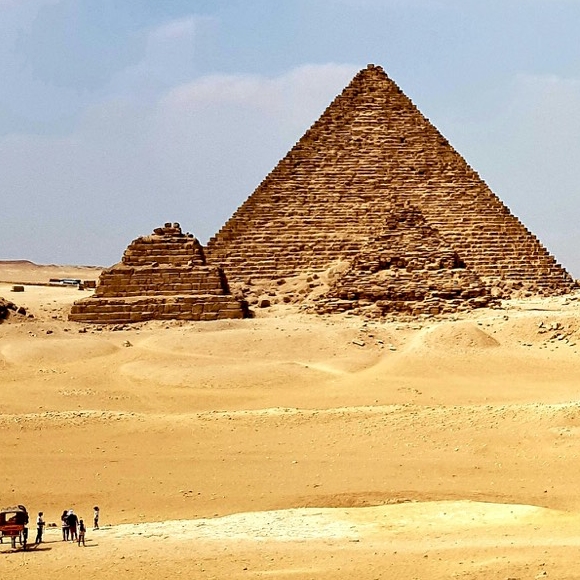
After breakfast, you'll begin your tour of the pyramids. The Step Pyramid of Saqqara dates back to around 2650 BC and is the first monumental stone building in Egypt. One of the first true pyramids to have an outer casing is the Bent Pyramid of Dahshur. During its construction, the angle of its slope had to be changed from 54° to 43° because the structure was in danger of collapsing. Afterward, you'll visit what is arguably the most famous archaeological site in the world. The Giza plateau has been a UNESCO World Heritage Site since 1979 and is also the only remaining Wonder of the Ancient World. In addition to the three Great Pyramids of Giza—Cheops, Khafre, and Menkaure—mortuary temples, several subsidiary pyramids, and numerous smaller tombs for officials were also built here. Another highlight is the world-famous Sphinx, a mythical creature resembling a man and a lion, which guards the royal tombs. These marvels were created at the height of the Old Kingdom, around 4,500 years ago. You have the entire afternoon to explore these impressive structures and the necropolis of the priest Qar. At this evening's farewell dinner, you can reminisce about the experiences and impressions of the past few days. Breakfast, lunch and dinner are included today. You will stay in the same accommodation as the previous day.
The Pyramids of Giza
Day 10
Belle Epoque Villa
approx. 70 km
After breakfast, you'll begin your tour of the pyramids. The Step Pyramid of Saqqara dates back to around 2650 BC and is the first monumental stone building in Egypt. One of the first true pyramids to have an outer casing is the Bent Pyramid of Dahshur. During its construction, the angle of its slope had to be changed from 54° to 43° because the structure was in danger of collapsing. Afterward, you'll visit what is arguably the most famous archaeological site in the world. The Giza plateau has been a UNESCO World Heritage Site since 1979 and is also the only remaining Wonder of the Ancient World. In addition to the three Great Pyramids of Giza—Cheops, Khafre, and Menkaure—mortuary temples, several subsidiary pyramids, and numerous smaller tombs for officials were also built here. Another highlight is the world-famous Sphinx, a mythical creature resembling a man and a lion, which guards the royal tombs. These marvels were created at the height of the Old Kingdom, around 4,500 years ago. You have the entire afternoon to explore these impressive structures and the necropolis of the priest Qar. At this evening's farewell dinner, you can reminisce about the experiences and impressions of the past few days. Breakfast, lunch and dinner are included today. You will stay in the same accommodation as the previous day.
Day 11
Welcome Home
approx. 20 km
Today it's time to pack your suitcase and head to the airport. You're flying back home, with many wonderful memories of a journey back in time to the land of the pharaohs. Breakfast is included.
Welcome Home
Day 11
approx. 20 km
Today it's time to pack your suitcase and head to the airport. You're flying back home, with many wonderful memories of a journey back in time to the land of the pharaohs. Breakfast is included.
Services
What's included
Guaranteed execution of all appointments
Rail&Fly in 1st class on DB trains to and from the airport
Scheduled flight with Egypt Air to Cairo and back (booking class L)
Domestic flights with Egypt Air from Cairo to Luxor and from Aswan to Cairo
Transfers in the destination country
Air-conditioned minibus
German-speaking local tour guide
10 nights in hotels and guesthouses as well as on a traditional dahabiya
Daily breakfast, 1 picnic, 8 lunches, 8 dinners
4-day Nile cruise on a traditional Dahabiya from Esna to Aswan
During your stay on the Dahabiya, selected drinks will be served with your meals.
Koshari in Cairo costs
Visit to the New Egyptian Museum (GEM)
Boat trip through the Nile cataracts near Aswan
Entrance fees
Purchase and protection of 70 m² of rainforest in your name
Small group with a maximum of 12 guests
What's not included
Travel insurance (we are happy to put together an individual offer)
personal equipment
Visa and vaccinations, if required
Tip
Drinks and meals not mentioned
personal expenses
Feeder flights, other departure airports or Rail&Fly (we are happy to put together a suitable offer)
Character of the trip
Fitness
Easy
Altitude
Low
Culture / nature
Pure culture
This small-group tour with a maximum of 12 guests is ideal for anyone who wants to experience a country intensively and with all their senses. You'll be accompanied by a German-speaking local guide. No special level of fitness is required, but you should enjoy meeting new people, taking walks, and experiencing new things.
Dates and prices
Group dates
Single room supplement: €1,400
Notes on the trip
Route
Approximately 860 km within the country (excluding flights)
Notes
Changes to the itinerary are possible. This trip is generally not suitable for people with reduced mobility. In individual cases, we are happy to check whether we can still accommodate your travel wishes. Please contact us.