Japan
Japan - Kyoto
Japan - Kyoto
Duration
15 days
Start/End
Tokyo/Osaka
Tour type
Group
Level
Simple
Accommodation
Hotels and Lodges
Overview
For 1,074 years Kyoto was the seat of the imperial court, and 1,600 Buddhist temples bear witness to it. On this tour with a maximum of twelve guests and a local guide you also discover Tokyo, Nikkō, Fuji, Hiroshima, Miyajima, Osaka and Kōya-san, and hike on the Kumano Kodo pilgrimage trail.
For 1,074 years, Kyoto was the seat of the imperial court. Overwhelming cultural treasures and 1,600 Buddhist temples bear witness to this venerable era. Among them is the masterpiece of all temples, Kiyomizu-dera. Legend has it that anyone who jumps from its terrace will have a wish granted. But don't do that; instead, join us in the "Sunshine City" of Nikko, the Fuji-Hakone-Izu National Park, Hiroshima, Osaka, and along the World Heritage Route to Kumano Hongu Taishavon, the main shrine of over 3,000 shrines. The megacities of Tokyo, Osaka, and Kyoto await you, along with a boat trip in the Fuji region and the UNESCO World Heritage Site of Himeji Castle. You'll hike the Kumano Kodo pilgrimage route, participate in a morning prayer service at a temple, and relax in hot springs during an onsen visit. Beyond the modern glitz and glamour of its metropolises, Japan embodies a profound spirituality that you will experience on your journey. You will stay in temple accommodations on Mount Koya and hike the historic Kumano Kodo pilgrimage route.
Tour Code
Tour language
 German
Itinerary
Day 1
Big in Japan
Today your flight to Japan, with its 2,500-year-old culture, begins. Off to the legendary land of the samurai!
Big in Japan
Day 1
Today your flight to Japan, with its 2,500-year-old culture, begins. Off to the legendary land of the samurai!
Day 2
Konnichiwa Tokio!
VIA INN Nihonbashi Ningyocho
Upon landing, you will be met at Tokyo Airport. Your tour guide will greet you and accompany you to your accommodation. Afterwards, you will receive your first overview of Tokyo. The tour begins at the City Hall, whose two towers, at 243 meters, are the tallest in the area. From an observation deck, you can admire the surreal sea of houses that once formed part of a fishing village. Tokyo is now considered one of the world's largest metropolitan areas. Despite the crowds, the ubiquitous neon lights, and the traffic, everything here runs efficiently and smoothly. After this initial impression, you will have the opportunity to reflect on your experiences so far and recover from your journey at the hotel. Dinner is included in the price. Accommodation in Tokyo varies from date to date due to high demand. VIA INN Nihonbashi Ningyocho: The VIA INN Nihonbashi Ningyocho welcomes you to a central location in the bustling Nihonbashi district, where historical and modern architecture blend seamlessly. Many attractions, such as the Imperial Palace and the Kanda Myojin Shrine, are just a short walk from the hotel. The comfortably furnished rooms invite you to relax. Breakfast, a combination of Japanese and Western dishes, provides the perfect start to an eventful day.
Konnichiwa Tokio!
Day 2
VIA INN Nihonbashi Ningyocho
Upon landing, you will be met at Tokyo Airport. Your tour guide will greet you and accompany you to your accommodation. Afterwards, you will receive your first overview of Tokyo. The tour begins at the City Hall, whose two towers, at 243 meters, are the tallest in the area. From an observation deck, you can admire the surreal sea of houses that once formed part of a fishing village. Tokyo is now considered one of the world's largest metropolitan areas. Despite the crowds, the ubiquitous neon lights, and the traffic, everything here runs efficiently and smoothly. After this initial impression, you will have the opportunity to reflect on your experiences so far and recover from your journey at the hotel. Dinner is included in the price. Accommodation in Tokyo varies from date to date due to high demand. VIA INN Nihonbashi Ningyocho: The VIA INN Nihonbashi Ningyocho welcomes you to a central location in the bustling Nihonbashi district, where historical and modern architecture blend seamlessly. Many attractions, such as the Imperial Palace and the Kanda Myojin Shrine, are just a short walk from the hotel. The comfortably furnished rooms invite you to relax. Breakfast, a combination of Japanese and Western dishes, provides the perfect start to an eventful day.
Day 3
Tokio Underground
VIA INN Nihonbashi Ningyocho
Today you'll take the subway, the world's busiest. After just a few stops, you'll reach Harajuku. Quiet and traditional on one side of the station, with Meiji Park and the shrine of the same name, hip, colorful, and loud on the other. Contrasts like these are what make Tokyo so fascinating. Next, you'll head to the lively Ueno Park. This park commemorates a bloody samurai battle in 1868. Today, this idyllic park, with its lake and Benten-do, a Buddhist temple, is a popular meeting place for Tokyoites. Your next stop is Ameyokocho Market, where you'll find every imaginable consumer good at over 180 stalls. The sweets at the candy stands are especially recommended. From there, the subway takes you to the traditional Asakusa district. Here, the city's old character has been preserved. Although it was not spared the devastating Great Kanto Earthquake of 1923 or the Allied bombings after World War II, the Asakusa Temple and the Thunder Gate impress not only with their enchanting atmosphere. To truly experience this metropolis, one must, of course, cross the world's busiest intersection in Shibuya. Up to 15,000 people cross the streets here – during each green light! Breakfast is included in the price. You will stay in the same accommodation as the previous day.
Tokio Underground
Day 3
VIA INN Nihonbashi Ningyocho
Today you'll take the subway, the world's busiest. After just a few stops, you'll reach Harajuku. Quiet and traditional on one side of the station, with Meiji Park and the shrine of the same name, hip, colorful, and loud on the other. Contrasts like these are what make Tokyo so fascinating. Next, you'll head to the lively Ueno Park. This park commemorates a bloody samurai battle in 1868. Today, this idyllic park, with its lake and Benten-do, a Buddhist temple, is a popular meeting place for Tokyoites. Your next stop is Ameyokocho Market, where you'll find every imaginable consumer good at over 180 stalls. The sweets at the candy stands are especially recommended. From there, the subway takes you to the traditional Asakusa district. Here, the city's old character has been preserved. Although it was not spared the devastating Great Kanto Earthquake of 1923 or the Allied bombings after World War II, the Asakusa Temple and the Thunder Gate impress not only with their enchanting atmosphere. To truly experience this metropolis, one must, of course, cross the world's busiest intersection in Shibuya. Up to 15,000 people cross the streets here – during each green light! Breakfast is included in the price. You will stay in the same accommodation as the previous day.
Day 4
Beautiful Nikko
VIA INN Nihonbashi Ningyocho
In the morning, you'll travel by train through the Kanto Plain to Nikko. The "Sunshine City" lies in the mountains north of Tokyo, and its shrines and temples are a UNESCO World Heritage Site. The temple architecture dates back to the Shogunate era and is unparalleled in Japan in both its craftsmanship and aesthetics. Among the impressive carvings on over 100 buildings are the famous three wise monkeys, who see, hear, and speak no evil. You'll visit the colorful Toshogu Shrine, built in honor of the ruler Tokugawa Ieyasu. The Futarasan Shrine impresses with its simple design and numerous lanterns. The red Shinkyo Bridge over the Daiya River offers a fantastic photo opportunity. Later, you'll return to Tokyo by train. The included meals consist of breakfast and lunch at a local restaurant. The train journey covers approximately 340 km. The journey time is approximately 5 hours. You will stay in the same accommodation as the previous day.
Beautiful Nikko
Day 4
VIA INN Nihonbashi Ningyocho
In the morning, you'll travel by train through the Kanto Plain to Nikko. The "Sunshine City" lies in the mountains north of Tokyo, and its shrines and temples are a UNESCO World Heritage Site. The temple architecture dates back to the Shogunate era and is unparalleled in Japan in both its craftsmanship and aesthetics. Among the impressive carvings on over 100 buildings are the famous three wise monkeys, who see, hear, and speak no evil. You'll visit the colorful Toshogu Shrine, built in honor of the ruler Tokugawa Ieyasu. The Futarasan Shrine impresses with its simple design and numerous lanterns. The red Shinkyo Bridge over the Daiya River offers a fantastic photo opportunity. Later, you'll return to Tokyo by train. The included meals consist of breakfast and lunch at a local restaurant. The train journey covers approximately 340 km. The journey time is approximately 5 hours. You will stay in the same accommodation as the previous day.
Day 5
Contemplative temples and a holy mountain
The Noborisaka Hotel
approx. 140 km
You'll travel by bus from Tokyo to Kamakura, the 13th-century capital of Japan and the seat of the shoguns. Buddhism flourished here, as evidenced by the over 750-year-old, 120-ton Buddha statue. You'll also see the Hase Kannon Temple, home to an eleven-headed wooden statue of Kannon. The journey continues to Hakone in the Fuji-Hakone-Izu National Park. Upon arrival, a magical boat trip awaits you in the Fuji region. Weather permitting, you'll have a unique view of Japan's highest peak, Mount Fuji. Breakfast and dinner with a magnificent view are included. For your comfort, you'll travel tomorrow on the Shinkansen bullet train with only light luggage. Your main luggage will be transported by a reliable delivery service from Mount Fuji directly to Osaka within 3 days (2 nights). Please pack a small bag or backpack today for the next three days and the two overnight stays in Hiroshima. Alternatively, you can carry your main luggage with you on the Shinkansen. The Noborisaka Hotel: At the Noborisaka Hotel, you only need to step outside in the morning to admire Mount Fuji, this mighty volcano nearly 4,000 meters high, weather permitting. You can relax after taking in the view in the sauna or the onsen, a traditional Japanese hot spring bath. The hotel's buffet restaurant, Choice Kitchen, serves breakfast and dinner featuring contemporary Japanese cuisine made with fresh, homegrown vegetables. You'll stay in comfortable rooms.
Contemplative temples and a holy mountain
Day 5
The Noborisaka Hotel
approx. 140 km
You'll travel by bus from Tokyo to Kamakura, the 13th-century capital of Japan and the seat of the shoguns. Buddhism flourished here, as evidenced by the over 750-year-old, 120-ton Buddha statue. You'll also see the Hase Kannon Temple, home to an eleven-headed wooden statue of Kannon. The journey continues to Hakone in the Fuji-Hakone-Izu National Park. Upon arrival, a magical boat trip awaits you in the Fuji region. Weather permitting, you'll have a unique view of Japan's highest peak, Mount Fuji. Breakfast and dinner with a magnificent view are included. For your comfort, you'll travel tomorrow on the Shinkansen bullet train with only light luggage. Your main luggage will be transported by a reliable delivery service from Mount Fuji directly to Osaka within 3 days (2 nights). Please pack a small bag or backpack today for the next three days and the two overnight stays in Hiroshima. Alternatively, you can carry your main luggage with you on the Shinkansen. The Noborisaka Hotel: At the Noborisaka Hotel, you only need to step outside in the morning to admire Mount Fuji, this mighty volcano nearly 4,000 meters high, weather permitting. You can relax after taking in the view in the sauna or the onsen, a traditional Japanese hot spring bath. The hotel's buffet restaurant, Choice Kitchen, serves breakfast and dinner featuring contemporary Japanese cuisine made with fresh, homegrown vegetables. You'll stay in comfortable rooms.
Day 6
Around Mount Fuji and on to Hiroshima
Mitsui Garden Hotel
After breakfast, you can enjoy a breathtaking view from Oishi Park overlooking Lake Kawaguchi and Mount Fuji. Afterwards, you'll circle the sacred mountain on your way to Shin-Fuji Shinkansen Station, making further photo stops at viewpoints such as Motosu Lake and Shiraito Waterfall. The high-speed train will then take you to Hiroshima. The city has been etched in world history since the first atomic bomb was dropped in August 1945. However, Hiroshima's history dates back to the 13th century. The city developed from a castle to an imperial residence and has flourished to its present state. It is considered a regional cultural center and a memorial site that advocates for global peace. Upon arrival in Hiroshima, you'll take your first walk. It's almost impossible to imagine that an atomic bomb once exploded here, hundreds of meters above the city, extinguishing life in an instant. Therefore, you'll also visit the Peace Memorial Park, the former Ground Zero. The park is considered the most important memorial to the victims of the atomic bombing. Among other things, the Peace Bell, which visitors are allowed to ring, serves as a reminder of this. At the Peace Museum, you have the opportunity to learn more details about the city's history before the attack. On your way to your hotel, you'll observe how vibrant life and joy have returned to this modern city. Breakfast is included in the price. You will receive a typical Japanese lunchbox for the journey. The train journey covers approximately 730 km. The journey time is approximately 4 hours. Mitsui Garden Hotel: The Mitsui Garden Hotel is centrally located in downtown Hiroshima. This modern hotel welcomes you with a friendly atmosphere. The charming rooms are decorated in light colors and comfortably furnished. The restaurants serve Japanese and international cuisine.
Around Mount Fuji and on to Hiroshima
Day 6
Mitsui Garden Hotel
After breakfast, you can enjoy a breathtaking view from Oishi Park overlooking Lake Kawaguchi and Mount Fuji. Afterwards, you'll circle the sacred mountain on your way to Shin-Fuji Shinkansen Station, making further photo stops at viewpoints such as Motosu Lake and Shiraito Waterfall. The high-speed train will then take you to Hiroshima. The city has been etched in world history since the first atomic bomb was dropped in August 1945. However, Hiroshima's history dates back to the 13th century. The city developed from a castle to an imperial residence and has flourished to its present state. It is considered a regional cultural center and a memorial site that advocates for global peace. Upon arrival in Hiroshima, you'll take your first walk. It's almost impossible to imagine that an atomic bomb once exploded here, hundreds of meters above the city, extinguishing life in an instant. Therefore, you'll also visit the Peace Memorial Park, the former Ground Zero. The park is considered the most important memorial to the victims of the atomic bombing. Among other things, the Peace Bell, which visitors are allowed to ring, serves as a reminder of this. At the Peace Museum, you have the opportunity to learn more details about the city's history before the attack. On your way to your hotel, you'll observe how vibrant life and joy have returned to this modern city. Breakfast is included in the price. You will receive a typical Japanese lunchbox for the journey. The train journey covers approximately 730 km. The journey time is approximately 4 hours. Mitsui Garden Hotel: The Mitsui Garden Hotel is centrally located in downtown Hiroshima. This modern hotel welcomes you with a friendly atmosphere. The charming rooms are decorated in light colors and comfortably furnished. The restaurants serve Japanese and international cuisine.
Day 7
Miyajima: a beautiful view
Mitsui Garden Hotel
You begin your day with a visit to Hiroshima's iconic landmark, the Atomic Bomb Dome, a UNESCO World Heritage Site. This ruin of the former Chamber of Commerce and Industry features a distinctive domed roof visible from afar. Afterward, you'll take a streetcar to the ferry terminal on the city's outskirts. From there, a ferry will take you to the sacred shrine island of Miyajima, one of Japan's three most beautiful landscapes, the "Nihon Sankei." Here, you'll visit Itsukushima Shrine, world-famous for its red torii gate that appears to float in the water at high tide. Finally, soak up the mystical atmosphere at the Daishoin Buddhist temple at the foot of Mount Misen before returning to Hiroshima. The included meal is breakfast. You will receive your main piece of luggage back tomorrow in Osaka. You will stay in the same accommodation as the previous day.
Miyajima: a beautiful view
Day 7
Mitsui Garden Hotel
You begin your day with a visit to Hiroshima's iconic landmark, the Atomic Bomb Dome, a UNESCO World Heritage Site. This ruin of the former Chamber of Commerce and Industry features a distinctive domed roof visible from afar. Afterward, you'll take a streetcar to the ferry terminal on the city's outskirts. From there, a ferry will take you to the sacred shrine island of Miyajima, one of Japan's three most beautiful landscapes, the "Nihon Sankei." Here, you'll visit Itsukushima Shrine, world-famous for its red torii gate that appears to float in the water at high tide. Finally, soak up the mystical atmosphere at the Daishoin Buddhist temple at the foot of Mount Misen before returning to Hiroshima. The included meal is breakfast. You will receive your main piece of luggage back tomorrow in Osaka. You will stay in the same accommodation as the previous day.
Day 8
White Heron Castle and Osaka Water City
Hotel Vista Osaka Namba
During today's Shinkansen ride, the landscape unfolds before you like a film outside the window, and you can observe life along the railway line. Then, gleaming white, Himeji Castle, arguably the most famous and beautiful in the entire country, comes into view. This perfectly preserved 14th-century fortress is also a UNESCO World Heritage Site. Several renovations have maintained the splendor of the complex, including the beautiful Koko-en Garden. Afterwards, you'll continue your journey by train to Osaka. Because of its many canals and waterways, the city is also known as the Venice of the East. The lively and vibrant atmosphere continues in the popular Dotonbori district, known for its lively nightlife and bars. Here you can end your day. Osaka is also famous for its many street food options. Enjoy your meal! The included meals consist of breakfast. The train journey covers approximately 350 km. The journey time is approximately 2 hours. For your comfort, you will travel tomorrow on the Shinkansen high-speed train with only light luggage. Your main piece of luggage will be transported overnight from Osaka to Kawayu Onsen by a reliable delivery service. Please pack a small bag or backpack tonight for the next two days and the overnight stay in Koya-san. Accommodation in Osaka varies from date to date due to high demand. Hotel Vista Osaka Namba: Located near the popular Dotonbori entertainment district, Hotel Vista Osaka Namba is an ideal base for exploring the city. In addition to numerous shopping opportunities, you'll also find restaurants and bars nearby. The rooms are comfortably and modernly furnished, offering peace and relaxation away from the hustle and bustle of the city. The "Vista Café" serves a breakfast buffet with a wide variety of regional and international delicacies, ensuring a satisfying start to your day.
White Heron Castle and Osaka Water City
Day 8
Hotel Vista Osaka Namba
During today's Shinkansen ride, the landscape unfolds before you like a film outside the window, and you can observe life along the railway line. Then, gleaming white, Himeji Castle, arguably the most famous and beautiful in the entire country, comes into view. This perfectly preserved 14th-century fortress is also a UNESCO World Heritage Site. Several renovations have maintained the splendor of the complex, including the beautiful Koko-en Garden. Afterwards, you'll continue your journey by train to Osaka. Because of its many canals and waterways, the city is also known as the Venice of the East. The lively and vibrant atmosphere continues in the popular Dotonbori district, known for its lively nightlife and bars. Here you can end your day. Osaka is also famous for its many street food options. Enjoy your meal! The included meals consist of breakfast. The train journey covers approximately 350 km. The journey time is approximately 2 hours. For your comfort, you will travel tomorrow on the Shinkansen high-speed train with only light luggage. Your main piece of luggage will be transported overnight from Osaka to Kawayu Onsen by a reliable delivery service. Please pack a small bag or backpack tonight for the next two days and the overnight stay in Koya-san. Accommodation in Osaka varies from date to date due to high demand. Hotel Vista Osaka Namba: Located near the popular Dotonbori entertainment district, Hotel Vista Osaka Namba is an ideal base for exploring the city. In addition to numerous shopping opportunities, you'll also find restaurants and bars nearby. The rooms are comfortably and modernly furnished, offering peace and relaxation away from the hustle and bustle of the city. The "Vista Café" serves a breakfast buffet with a wide variety of regional and international delicacies, ensuring a satisfying start to your day.
Day 9
Spiritual experiences in Koya-san
Fukuchiin
The journey continues by train. During the ride, you'll notice the landscape becoming increasingly verdant until you reach the town of Koya-san, nestled on a densely forested plateau. A spiritual place where a quarter of the residents are monks, Koya-san is a must-see. Finally, a cog railway takes you up to the mountain of the Buddhist temple complex. This complex encompasses over 100 temples, as well as a school and a library dedicated to the teachings of Buddha. A guided walk will take you to Oku-no-in, Japan's largest and most famous cemetery. Here, emperors, empresses, poets, and other national figures are laid to rest. As you continue your walk, you'll admire numerous Buddhist temples, for Koya-san is a sacred site and a UNESCO World Heritage Site. Savor this atmosphere of spiritual energy and breathtaking natural beauty. Breakfast and dinner are included in the price. The train journey covers approximately 110 km. The journey time is approximately 1 ½ hours. You will receive your main piece of luggage back tomorrow in Kawayu Onsen. Fukuchiin: At the Fukuchiin temple accommodation, your stay becomes a spiritual experience. Surrounded by monastic life, amidst temples and gardens, your focus will soon naturally shift to what truly matters. You'll stay in a traditional room with a shared bathroom and sleep on a futon, a comfortable, padded floor mat. Traditional vegetarian dishes will be served. Learn to appreciate the simplicity of your accommodation and become part of the monastic community for a night.
Spiritual experiences in Koya-san
Day 9
Fukuchiin
The journey continues by train. During the ride, you'll notice the landscape becoming increasingly verdant until you reach the town of Koya-san, nestled on a densely forested plateau. A spiritual place where a quarter of the residents are monks, Koya-san is a must-see. Finally, a cog railway takes you up to the mountain of the Buddhist temple complex. This complex encompasses over 100 temples, as well as a school and a library dedicated to the teachings of Buddha. A guided walk will take you to Oku-no-in, Japan's largest and most famous cemetery. Here, emperors, empresses, poets, and other national figures are laid to rest. As you continue your walk, you'll admire numerous Buddhist temples, for Koya-san is a sacred site and a UNESCO World Heritage Site. Savor this atmosphere of spiritual energy and breathtaking natural beauty. Breakfast and dinner are included in the price. The train journey covers approximately 110 km. The journey time is approximately 1 ½ hours. You will receive your main piece of luggage back tomorrow in Kawayu Onsen. Fukuchiin: At the Fukuchiin temple accommodation, your stay becomes a spiritual experience. Surrounded by monastic life, amidst temples and gardens, your focus will soon naturally shift to what truly matters. You'll stay in a traditional room with a shared bathroom and sleep on a futon, a comfortable, padded floor mat. Traditional vegetarian dishes will be served. Learn to appreciate the simplicity of your accommodation and become part of the monastic community for a night.
Day 10
Hiking on the Kumano Kodo pilgrimage route
Kawayumidoriya
approx. 130 km
Still deep in thought, you'll participate in an early morning service or take a stroll through the beautiful surroundings. Afterward, you'll travel by bus from Koya-san to Hosshinmon-oji, from where you'll begin your hike on the Kumano Kodo. This 1,000-year-old pilgrimage route is partnered with the Camino de Santiago and is considered one of Japan's holiest trails. Throughout the day, you'll learn more about its history. The many encounters along the way are also fascinating. Your destination for today's hike is the Kumano Hongu Taisha Grand Shrine with its beautifully curved cedar bark roofs. It's one of the three main shrines of the Kumano faith. After visiting the shrine, you'll continue by bus to Kawayu Onsen. To truly experience Japan, you must visit an onsen at least once. It's an ancient tradition to sit together in the hot spring water and relax. The included meals consist of breakfast and dinner. The moderately difficult hiking trail covers approximately 8 km with 190 meters of elevation gain and 460 meters of elevation loss. The hiking time is approximately 4 hours, and you should have sure footing. Kawayu Midoriya: The Kawayu Midoriya is located in Kawayu, an onsen town where visitors have enjoyed the soothing effects of hot springs for centuries. From the hotel, you have a direct view of the crystal-clear Oko River, where the springs bubble and people relax as warm steam rises around them. Join them or treat yourself to a bath in the hotel's own onsen. You'll stay in a traditionally furnished room with a futon, the comfortable Japanese floor mat. Traditional dishes await you for dinner.
Hiking on the Kumano Kodo pilgrimage route
Day 10
Kawayumidoriya
approx. 130 km
Still deep in thought, you'll participate in an early morning service or take a stroll through the beautiful surroundings. Afterward, you'll travel by bus from Koya-san to Hosshinmon-oji, from where you'll begin your hike on the Kumano Kodo. This 1,000-year-old pilgrimage route is partnered with the Camino de Santiago and is considered one of Japan's holiest trails. Throughout the day, you'll learn more about its history. The many encounters along the way are also fascinating. Your destination for today's hike is the Kumano Hongu Taisha Grand Shrine with its beautifully curved cedar bark roofs. It's one of the three main shrines of the Kumano faith. After visiting the shrine, you'll continue by bus to Kawayu Onsen. To truly experience Japan, you must visit an onsen at least once. It's an ancient tradition to sit together in the hot spring water and relax. The included meals consist of breakfast and dinner. The moderately difficult hiking trail covers approximately 8 km with 190 meters of elevation gain and 460 meters of elevation loss. The hiking time is approximately 4 hours, and you should have sure footing. Kawayu Midoriya: The Kawayu Midoriya is located in Kawayu, an onsen town where visitors have enjoyed the soothing effects of hot springs for centuries. From the hotel, you have a direct view of the crystal-clear Oko River, where the springs bubble and people relax as warm steam rises around them. Join them or treat yourself to a bath in the hotel's own onsen. You'll stay in a traditionally furnished room with a futon, the comfortable Japanese floor mat. Traditional dishes await you for dinner.
Day 11
Hiking on the Kumano Kodo pilgrimage route
Kawayumidoriya
approx. 50 km
Today's route takes you to the vermilion-red Kumano Hayatama Taisha Grand Shrine, hidden in the forest and the second of the three sacred sites on the mountainous Kii Peninsula. After visiting the shrine, you'll continue by bus to Nachisan. From there, you'll hike up the winding, gently ascending "Stairway to Heaven" from the valley to the third sacred Kumano Sanzan site, the Kumano Nachi Taisha Grand Shrine. This Shinto shrine and the neighboring Buddhist temple, Seihantoji, are picturesquely situated on a hilltop. As is typical for Shinto shrines, this one is also dedicated to a natural phenomenon: the roaring Nachi Waterfall, one of the highest waterfalls in Japan. This creates a magical scene and a unique photo opportunity of the multi-story temple pagoda with the waterfall in the background. The included meals are breakfast and dinner. The hiking trail is approximately 2.5 km long and includes some steep uphill sections. The hiking time is approximately 1.5 hours. You will stay in the same accommodation as the previous day.
Hiking on the Kumano Kodo pilgrimage route
Day 11
Kawayumidoriya
approx. 50 km
Today's route takes you to the vermilion-red Kumano Hayatama Taisha Grand Shrine, hidden in the forest and the second of the three sacred sites on the mountainous Kii Peninsula. After visiting the shrine, you'll continue by bus to Nachisan. From there, you'll hike up the winding, gently ascending "Stairway to Heaven" from the valley to the third sacred Kumano Sanzan site, the Kumano Nachi Taisha Grand Shrine. This Shinto shrine and the neighboring Buddhist temple, Seihantoji, are picturesquely situated on a hilltop. As is typical for Shinto shrines, this one is also dedicated to a natural phenomenon: the roaring Nachi Waterfall, one of the highest waterfalls in Japan. This creates a magical scene and a unique photo opportunity of the multi-story temple pagoda with the waterfall in the background. The included meals are breakfast and dinner. The hiking trail is approximately 2.5 km long and includes some steep uphill sections. The hiking time is approximately 1.5 hours. You will stay in the same accommodation as the previous day.
Day 12
Kyoto, Part One
Keio Prelia Hotel
approx. 250 km
You'll travel comfortably by bus to Kyoto, where a unique sight awaits you in the suburb of Uji. The graceful lines of the Byodo-in Temple's main hall give it the appearance of a majestic bird spreading its wings. Combined with its reflection in the large pond, it almost seems as if this hall, commonly known as the "Phoenix Hall," is floating above the ground. This view is one of the most famous in all of Japan and is also depicted on the reverse of the 10-yen coin. Kyoto, Japan's second capital, experienced a golden age of art and culture until the 12th century and is considered its cradle. However, wars have not spared the city. Nevertheless, Kyoto boasts a rich heritage, which fortunately saved it from destruction during World War II. One of Kyoto's most famous temples is the golden Kinkakuji Temple, situated amidst a garden of ponds and a UNESCO World Heritage Site. Besides its exceptionally beautiful architecture, which combines several Japanese architectural styles, the Reliquary Hall is particularly noteworthy, its upper floors being completely covered in gold leaf, hence its nickname, the "Golden Pavilion." After this eventful day, you can relax and unwind at the hotel. Breakfast is included. Accommodation in Kyoto varies from date to date due to high demand. Keio Prelia Hotel: The Keio Prelia Hotel is located in the heart of Kyoto. With its excellent subway connections, this newly opened hotel is an ideal base for exploring the ancient imperial capital. The rooms are decorated in dark wood tones and feature traditional Kyoto elements. In the morning, a delicious breakfast buffet awaits you, offering both Western and Japanese cuisine.
Kyoto, Part One
Day 12
Keio Prelia Hotel
approx. 250 km
You'll travel comfortably by bus to Kyoto, where a unique sight awaits you in the suburb of Uji. The graceful lines of the Byodo-in Temple's main hall give it the appearance of a majestic bird spreading its wings. Combined with its reflection in the large pond, it almost seems as if this hall, commonly known as the "Phoenix Hall," is floating above the ground. This view is one of the most famous in all of Japan and is also depicted on the reverse of the 10-yen coin. Kyoto, Japan's second capital, experienced a golden age of art and culture until the 12th century and is considered its cradle. However, wars have not spared the city. Nevertheless, Kyoto boasts a rich heritage, which fortunately saved it from destruction during World War II. One of Kyoto's most famous temples is the golden Kinkakuji Temple, situated amidst a garden of ponds and a UNESCO World Heritage Site. Besides its exceptionally beautiful architecture, which combines several Japanese architectural styles, the Reliquary Hall is particularly noteworthy, its upper floors being completely covered in gold leaf, hence its nickname, the "Golden Pavilion." After this eventful day, you can relax and unwind at the hotel. Breakfast is included. Accommodation in Kyoto varies from date to date due to high demand. Keio Prelia Hotel: The Keio Prelia Hotel is located in the heart of Kyoto. With its excellent subway connections, this newly opened hotel is an ideal base for exploring the ancient imperial capital. The rooms are decorated in dark wood tones and feature traditional Kyoto elements. In the morning, a delicious breakfast buffet awaits you, offering both Western and Japanese cuisine.
Day 13
Kyoto, Part Two
Keio Prelia Hotel
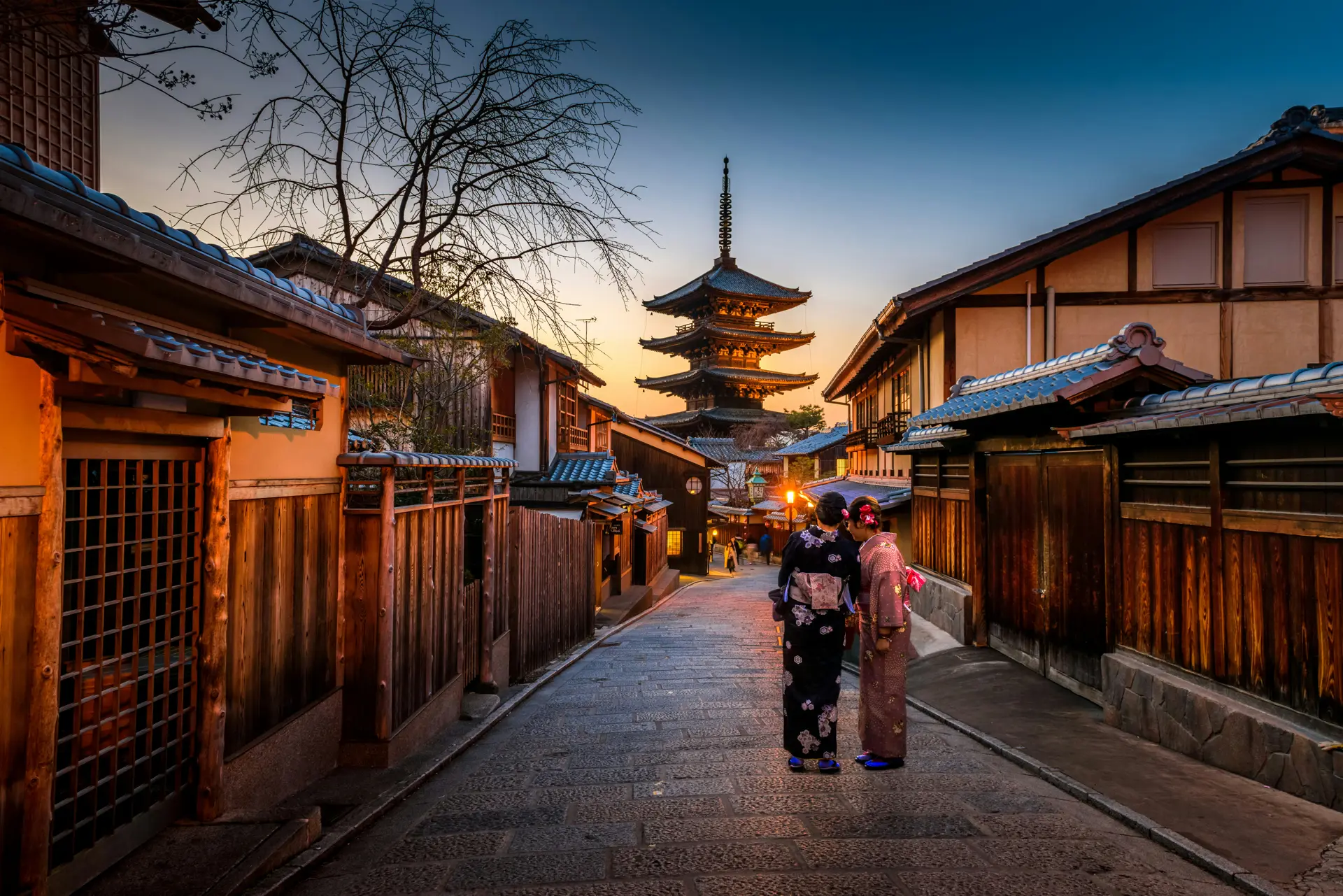
In the morning, you'll visit Heian-jingu, a Shinto shrine built in 1895. Besides the red city shrine, the beautiful Meiji-era garden surrounding it is also famous. Afterwards, you'll visit Chion-in Temple, an important center of Japanese Buddhism. The main temple of the Jodo school impresses with its monumental Sanmon Gate, one of the largest wooden temple gates in Japan, as well as its extensive temple grounds. The enormous temple bell is particularly impressive – one of the largest in the country. Its deep sound echoes throughout Kyoto every New Year's Eve. The picturesque old town district of Ninenzaka, with its charming shops, invites you to a lively lunch break. Afterwards, something truly special awaits you: you'll participate in a Japanese tea ceremony and learn how to prepare green matcha tea. On your way back to your accommodation, you'll stroll through the well-preserved old town district of Gion with its traditional buildings and teahouses. With a little luck, you might encounter a real geisha on her way to an appointment or a "geisha in training," a so-called maiko. In the afternoon, you'll have time to explore the city on your own. We recommend a visit to the Nishiki Market. How about some green tea ice cream? Breakfast is included. You will stay in the same accommodation as the previous day.
Kyoto, Part Two
Day 13
Keio Prelia Hotel
In the morning, you'll visit Heian-jingu, a Shinto shrine built in 1895. Besides the red city shrine, the beautiful Meiji-era garden surrounding it is also famous. Afterwards, you'll visit Chion-in Temple, an important center of Japanese Buddhism. The main temple of the Jodo school impresses with its monumental Sanmon Gate, one of the largest wooden temple gates in Japan, as well as its extensive temple grounds. The enormous temple bell is particularly impressive – one of the largest in the country. Its deep sound echoes throughout Kyoto every New Year's Eve. The picturesque old town district of Ninenzaka, with its charming shops, invites you to a lively lunch break. Afterwards, something truly special awaits you: you'll participate in a Japanese tea ceremony and learn how to prepare green matcha tea. On your way back to your accommodation, you'll stroll through the well-preserved old town district of Gion with its traditional buildings and teahouses. With a little luck, you might encounter a real geisha on her way to an appointment or a "geisha in training," a so-called maiko. In the afternoon, you'll have time to explore the city on your own. We recommend a visit to the Nishiki Market. How about some green tea ice cream? Breakfast is included. You will stay in the same accommodation as the previous day.
Day 14
Kyoto for the third time
Keio Prelia Hotel
In the morning, you'll visit Sanjusangendo Temple. The army of 1,000 life-size, gilded Kannon statues, all dating from the 12th and 13th centuries, is particularly impressive. Afterward, you'll visit Higashi Honganji Temple, adorned with magnificent carvings – a true gem in Kyoto and a UNESCO World Heritage Site. Its Golden Hall is also one of the largest wooden buildings in the world. Following a lunch break at the modern Kyoto Station, you'll travel to the Fushimi Inari Taisha Shinto shrine, dedicated to the fox god, where worshippers have been donating orange torii gates for centuries. These gates stand close together, forming a kilometer-long tunnel that winds its way up the mountain in a vibrant orange hue. Back in Kyoto, you'll enjoy your final evening with a superb Japanese dinner. The meal is served in numerous small courses and artfully garnished with flowers, leaves, and other natural elements – almost too beautiful to eat. Breakfast and farewell dinner are included in the price. You will stay in the same accommodation as the previous day.
Kyoto for the third time
Day 14
Keio Prelia Hotel
In the morning, you'll visit Sanjusangendo Temple. The army of 1,000 life-size, gilded Kannon statues, all dating from the 12th and 13th centuries, is particularly impressive. Afterward, you'll visit Higashi Honganji Temple, adorned with magnificent carvings – a true gem in Kyoto and a UNESCO World Heritage Site. Its Golden Hall is also one of the largest wooden buildings in the world. Following a lunch break at the modern Kyoto Station, you'll travel to the Fushimi Inari Taisha Shinto shrine, dedicated to the fox god, where worshippers have been donating orange torii gates for centuries. These gates stand close together, forming a kilometer-long tunnel that winds its way up the mountain in a vibrant orange hue. Back in Kyoto, you'll enjoy your final evening with a superb Japanese dinner. The meal is served in numerous small courses and artfully garnished with flowers, leaves, and other natural elements – almost too beautiful to eat. Breakfast and farewell dinner are included in the price. You will stay in the same accommodation as the previous day.
Day 15
Goodbye
Your tour guide will accompany you to the airport in Osaka, where you will board your return flight. You'll take with you incredible stories, encounters, and experiences. After landing, you will continue your journey home. Since you will be taken to the airport early in the morning, breakfast at the hotel will not be possible. You will have plenty of opportunities to eat and drink at the airport before your flight.
Goodbye
Day 15
Your tour guide will accompany you to the airport in Osaka, where you will board your return flight. You'll take with you incredible stories, encounters, and experiences. After landing, you will continue your journey home. Since you will be taken to the airport early in the morning, breakfast at the hotel will not be possible. You will have plenty of opportunities to eat and drink at the airport before your flight.
Services
What's included
Guaranteed execution of all appointments
Rail&Fly in 1st class on DB trains to and from the airport
Scheduled flight with Lufthansa to Tokyo and back from Osaka (booking class S)
Transfers in the destination country
Journeys by bus and train as well as by public transport
German-speaking tour guide
13 nights in hotels, traditional guesthouses and a temple hostel
Daily breakfast, 1 lunch, 1 packed lunch on the train, 6 dinners
Take the express train from Fuji to Hiroshima, from Hiroshima to Osaka, and from Osaka to Koya-san.
Separate luggage transport from Mount Fuji to Osaka and from Osaka to Kawayu Onsen
Train journey through the Kanto Plain to Nikko
Boat trip in the Fuji region
Morning prayer in a temple
Onsen visit
Hiking on the Kumano Kodo pilgrimage route
National park fees and entrance fees
Purchase and protection of 86 m² of rainforest in your name
Small group with a maximum of 12 guests
What's not included
Travel insurance (we are happy to put together an individual offer)
personal equipment
Visa and vaccinations, if required
Tip
Drinks and meals not mentioned
personal expenses
Feeder flights, other departure airports or Rail&Fly (we are happy to put together a suitable offer)
Character of the trip
Fitness
Simple
Altitude
Low
Culture / nature
Pure culture
This small-group tour with a maximum of 12 guests is ideal for anyone who wants to experience a country intensively and with all their senses. You'll be accompanied by a German-speaking local guide. No special level of fitness is required, but you should enjoy meeting new people, taking walks, and experiencing new things.
Dates and prices
Group dates
Single room supplement: from €900
Notes on the trip
Route
Approximately 570 km within the country (excluding flights)
Notes
Changes to the itinerary are possible. This trip is generally not suitable for people with reduced mobility. In individual cases, we are happy to check whether we can still accommodate your travel wishes. Please contact us.